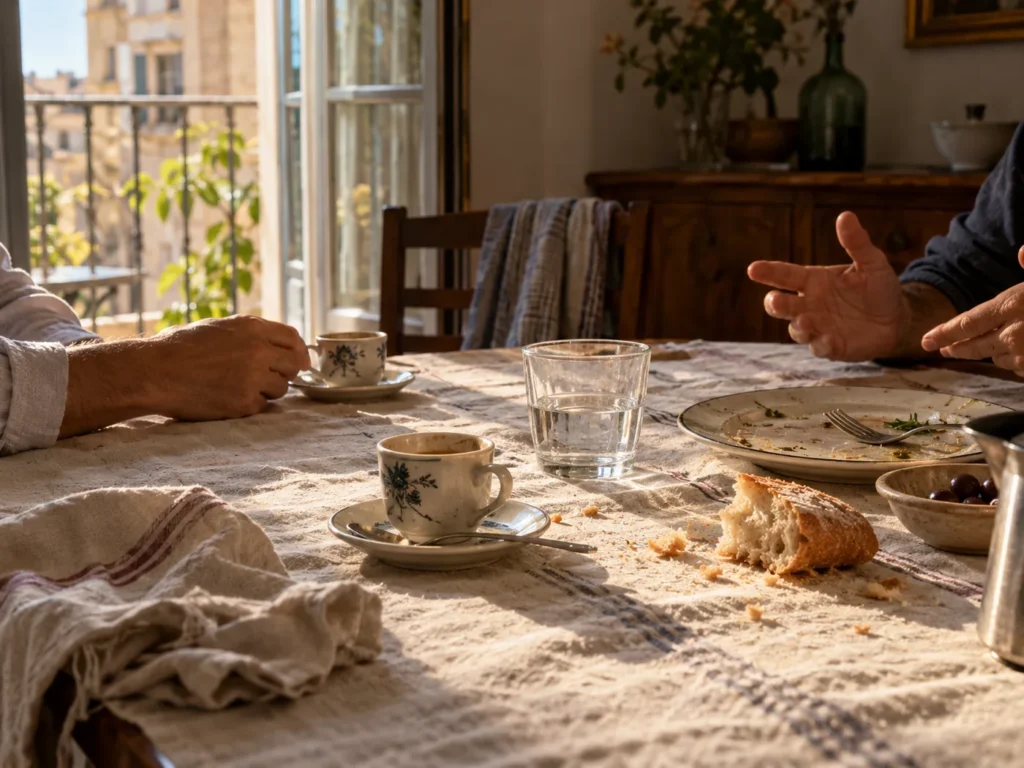
In Spain, life often happens a little slower.
Coffee is rarely taken to go. Lunch can last for hours. Evenings begin late and conversations tend to continue long after the plates are empty.
For many travelers visiting Spain, the biggest luxury is not a hotel or a restaurant. It is time itself.
Time to walk without rushing. Time to sit in a plaza. Time to talk. Time to enjoy small everyday rituals that still survive in many parts of the country.
Perhaps that is the real art of Spanish living.
Attention before an itinerary
Slow living begins with a change in attention. A familiar walk can become interesting when you notice the light on a wall, a shop window or the sound of rain. The experience does not need to be exceptional to deserve a few uninterrupted minutes.
On a trip, that attention benefits from a little space. Staying longer in one place means fewer arrivals, fewer departures and more opportunities to learn its ordinary rhythm. You may find a favorite breakfast, recognize a face or discover that a street looks different at the end of the day.
A table, a walk and an ordinary afternoon
A shared meal is one way to make time visible. Cooking something seasonal, setting the table and allowing conversation after eating can change the shape of a day. The Spanish sobremesa offers a name for that simple pleasure.
Walking gives another kind of freedom. You can choose a modest route, stop when you want and change direction without feeling that a plan has failed. In the Basque Country, the weather may help decide whether that afternoon belongs outside or around a table.
Making room within real life
Slow living is difficult to sustain when work, caregiving or money leaves little room to choose. Describing Spain as a country where nobody rushes would overlook the people who keep its kitchens, shops and transport running. Their schedules are part of the same landscape that a visitor enjoys.
A more useful approach starts with what is possible. Put a phone away for part of a meal. Choose one outing instead of three. Leave an errand until tomorrow when it can safely wait. A small decision repeated regularly may matter more than an ambitious promise to transform everything.
When the phone stops being the clock
A phone can turn a peaceful morning into a sequence of interruptions without ever making a sound. You check the weather and discover a message. The message leads to a headline. By the time you return to the coffee, the morning has acquired three concerns that were not sitting at the table a minute earlier.
Leaving the phone in a pocket for a while is a modest experiment, rather than a declaration of independence from modern life. Some people need to remain reachable. Others use it for directions, translation or contact with someone they love. The useful question is whether you are choosing the next interruption or merely receiving it.
Try letting one ordinary moment finish before opening the screen again. Drink the coffee while it is still warm. Watch the light move across the opposite wall. Hear the end of the other person’s sentence. Nothing remarkable may happen. That is part of the point: a moment does not have to produce useful information to deserve being lived completely.
The strange embarrassment of an empty hour
An afternoon with no appointment can feel surprisingly uncomfortable. We become skilled at accounting for our time, and an empty space may look like evidence that we have forgotten something. Even on holiday, it is tempting to fill it quickly with another attraction, another journey or another photograph proving the day was used properly.
There is another possibility. Sit somewhere pleasant and allow your interest to choose its own subject. A door opening, a dog refusing to move, the complicated negotiation over where a group will have lunch: the world is rarely short of material when we stop demanding that it entertain us in a particular way.
This is not an instruction to admire every inconvenience. Boredom exists; so do uncomfortable benches. But a little unassigned time can reveal what actually restores you. Perhaps you want company rather than another landscape. Perhaps you need sleep. Perhaps the best decision of the afternoon is to go back to your room. A slower rhythm allows those answers to arrive before the next booking does.
Company without an occasion
Friendship is often left waiting for a suitable event. We will meet when a birthday comes, when work settles down or when everyone can agree on a date. The calendar fills, and a person we meant to see becomes somebody whose news we follow through a screen.
An ordinary invitation lowers the threshold. A short walk, something simple to eat, a coffee without a long drive: these can make meeting less dependent on perfect conditions. Nobody needs to host a memorable evening. They need only to create a small place in the week where another person can be present.
There is a particular comfort in company that does not demand an update on every achievement. You can speak about a difficult day, or about nothing of consequence. Silence does not automatically mean the gathering has failed. Shared time can be useful precisely because it asks for very little. A life with more of those moments may still contain deadlines and crowded trains, but it has somewhere softer to return to.
A pace you can bring home
A quiet weekend in Rioja can offer a glimpse of another rhythm, but the value of that experience does not have to end with the journey. A favorite recipe, an evening walk or a regular meal with friends can carry some of it into daily life.
The aim is to give ordinary moments enough attention to become part of your memory. They are often the moments that disappear first when a day is treated only as a list of tasks.