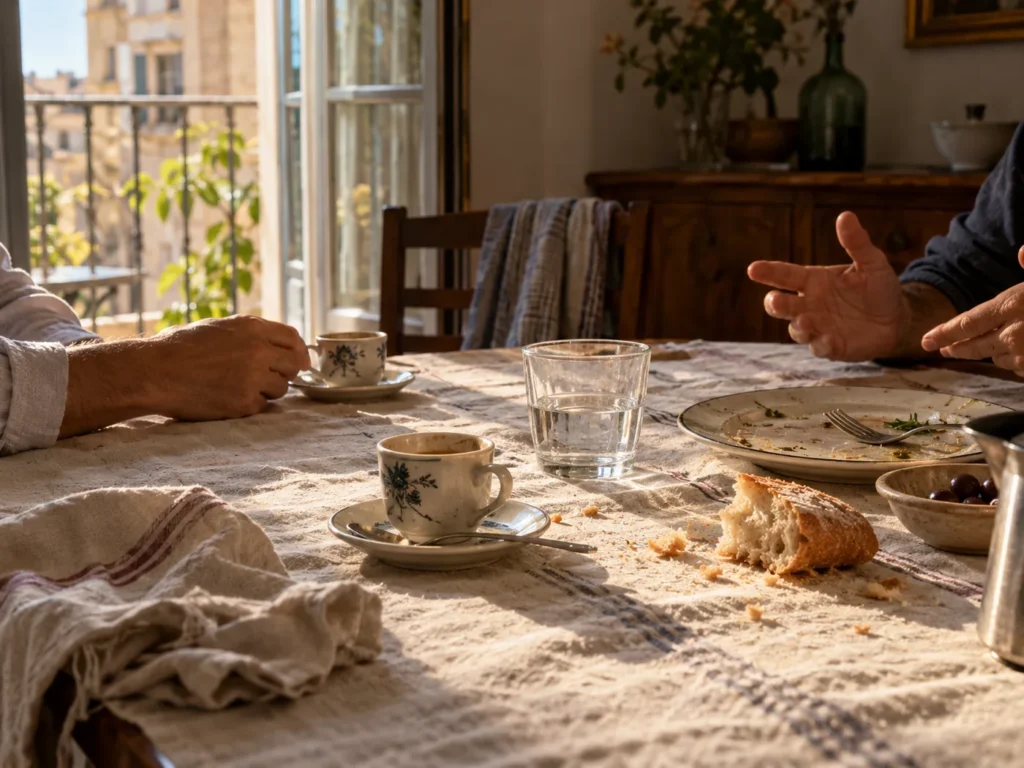
In the Basque Country, some of the most memorable meals do not happen in restaurants.
They happen inside private gastronomic societies known as txokos.
Behind discreet wooden doors, friends gather to cook, eat, drink wine and spend hours talking around long tables. Recipes are shared between generations, conversations become louder as the evening goes on and nobody seems to worry too much about time.
For many visitors, txokos reveal a side of the Basque Country that feels deeply authentic and difficult to find anywhere else in the world.
They are not simply places to eat. They are places to belong.
A society built around a shared kitchen
A txoko is a setting for cooking and company. The word is widely associated with Basque gastronomic societies: private associations whose members share a place to prepare meals and gather. Each has its own arrangements, so a visitor should avoid imagining that every society works in exactly the same way.
The Basque Government’s account of gastronomic societies emphasizes the role of members, shared cooking and recipes passed between people. That helps explain the appeal of the place. The kitchen belongs to the gathering rather than being hidden behind the service.
The pleasure of doing things together
Someone brings ingredients; someone else begins the preparation. A dish may prompt a discussion about how a relative used to make it. People exchange advice, offer help and eventually sit down to eat. The meal carries the work that went into it.
The cooking does not need to be elaborate to have meaning. Good ingredients, a familiar recipe and enough time to prepare it can provide a reason to meet. A shared kitchen also gives different generations an opportunity to pass on practical knowledge.
Being a guest
Many txokos are private, and access generally depends on a member’s invitation or an arrangement with the society. A visitor should ask rather than treat the entrance like the door of a restaurant. Rules about guests, use of the kitchen and participation differ from one association to another.
When invited, follow the host’s lead. Ask whether you can help, respect the society’s arrangements and request permission before photographing people. The experience is more rewarding when the room is treated as somebody else’s social space.
Before anybody sits down
Imagine arriving while the meal is still being prepared. There is no curtain separating the finished dish from the decisions that made it. You can see the chopping board, the pot being checked and the person who insists that a little more patience will improve everything. A kitchen offers conversation its own starting points.
In a restaurant, a guest generally meets a dish after the practical questions have been settled. Around a shared stove, those questions may become part of the gathering. When should the next ingredient go in? Is there enough for everybody? Who has moved the spoon? The last question can acquire an importance entirely disproportionate to the value of the spoon.
Cooking together also makes different kinds of confidence visible. One person works from memory; another wants quantities. Neither method guarantees a peaceful discussion, but the disagreement can be affectionate. The pleasure comes from making something in company and seeing how each person’s contribution changes the result. The table begins to belong to the group before it is even laid.
Recipes carried in gestures
A recipe can survive in writing, but some of its most useful details live elsewhere. The way a hand tests a texture, the sound that prompts somebody to lower the heat, the moment a cook decides to stop stirring: these are harder to pass on through a list of ingredients.
Watching someone prepare a familiar dish gives those details a setting. A younger person may ask a question that an experienced cook has never thought to explain. Teaching begins when something automatic has to become visible. The instruction may be imprecise at first: a little, enough, until it looks right. A second attempt makes the words more useful.
There is no need to imagine every shared kitchen as a storehouse of ancient secrets. New dishes arrive, people improvise and tastes change. A meal can remember the past while making room for the present. The important inheritance may be the willingness to show somebody how to do a small thing well, then let them try it in their own way.
Belonging includes the washing up
The romantic photograph of a long table rarely follows the evening to its practical conclusion. Cups remain, work surfaces need attention and somebody has to put the room back into a condition that the next people will appreciate. The gathering has a final chapter, and it is unlikely to be the one selected for the cover.
That chapter matters. A shared place depends on people remembering that they are borrowing it from one another. Leaving things ready is a form of hospitality toward someone who has not yet arrived. For a guest, offering help can be more meaningful than delivering an elaborate compliment about the meal.
Not every invitation becomes a lasting friendship, and it does not need to. You may leave knowing only a few names, with one cooking tip and a better understanding of the room. That is enough. A private social space should not be measured by how much access it grants a traveler. Its value begins with the people who maintain it, return to it and make it part of their lives.
Tradition with a present
Gastronomic societies have changed over time, and customs around membership and participation are not uniform. An account that treats every txoko as a scene from the past misses the people using these places today. Their choices give the tradition its present shape.
A txoko offers one way into everyday Basque culture. Another is simply to notice how much conversation can happen around a meal. When the plates are cleared, the time at the table may still have something to offer.