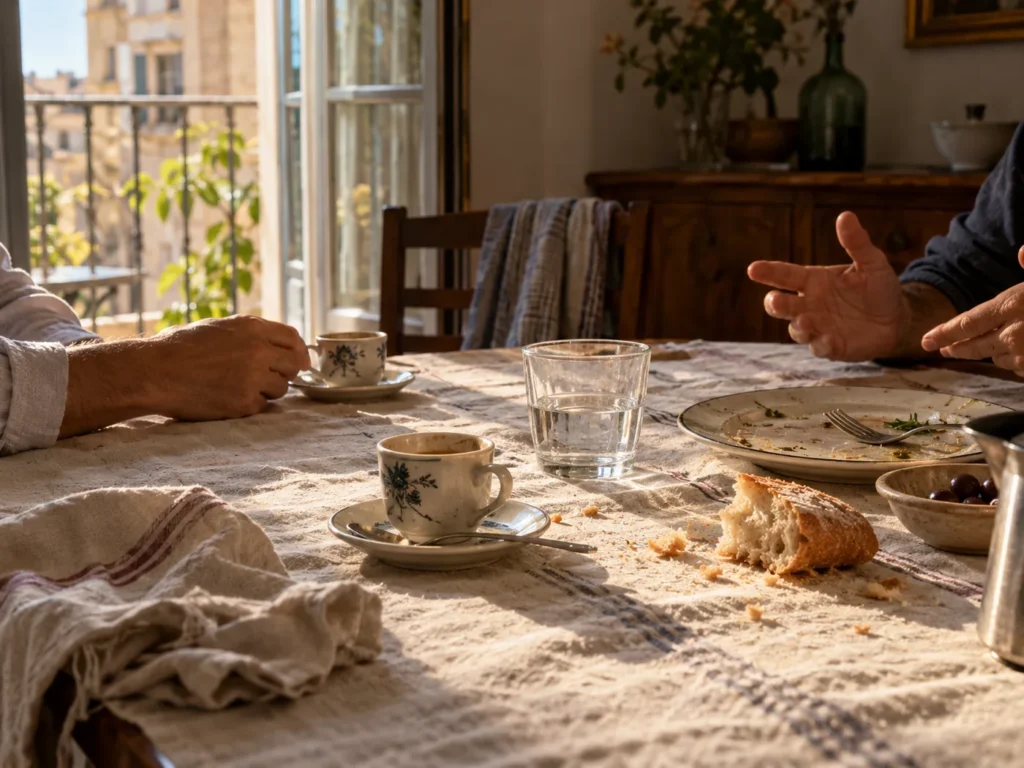
At the northwestern edge of the Iberian Peninsula lies a land that has long been associated with the end of the known world.
Galicia faces the Atlantic with granite cliffs, long beaches, deep estuaries, fishing ports, and a coastline that seems to fold endlessly into itself. Inland, green hills, old stone villages, vineyards, oak woods, and mist create a landscape that feels both physical and imagined.
Here, the sea is not simply scenery. It is work, food, danger, memory, and departure. Rain is not merely an inconvenience. It is one of the forces that made Galicia green. And melancholy is not necessarily sadness; in Galician culture, longing has acquired its own vocabulary.
Galicia is pilgrimage and tavern, stone cross and mussel raft, bagpipe and market, octopus and Atlantic wind.
Rías, Cliffs, and the Edge of the Atlantic
Galicia’s coastline is defined by its rías, estuaries where salt water reaches deep into the land.
In the north, the coast becomes more exposed and dramatic around places such as Cape Ortegal and Estaca de Bares, the northernmost point of the Iberian Peninsula. Farther south, the Rías Baixas are broader and more sheltered, creating ideal conditions for fishing, shellfish gathering, and the floating platforms known as bateas used especially for mussel cultivation.
To the west lies Fisterra — Finisterre — whose name still carries the old idea of the world’s edge. Nearby, the Costa da Morte tells a harsher story. Its rocky coast, powerful seas, shipwreck history, and isolated lighthouses have made it one of Spain’s most evocative maritime landscapes.
But Galicia also knows extraordinary softness. The Cíes Islands guard the entrance to the Ría de Vigo with pale sand, clear water, and protected natural habitats. Rodas Beach links two islands in a long curve that can look almost tropical on a bright day, even if the Atlantic water quickly reminds you where you are.
Stone, Forest, and the Road to Santiago
Galicia’s interior has its own rhythm.
Villages of granite appear between oak and chestnut woods. Pazos, once manor houses of rural elites, rise behind walls and gardens. Long stone and wooden hórreos preserve the memory of agricultural communities that needed to protect grain from damp and rodents.
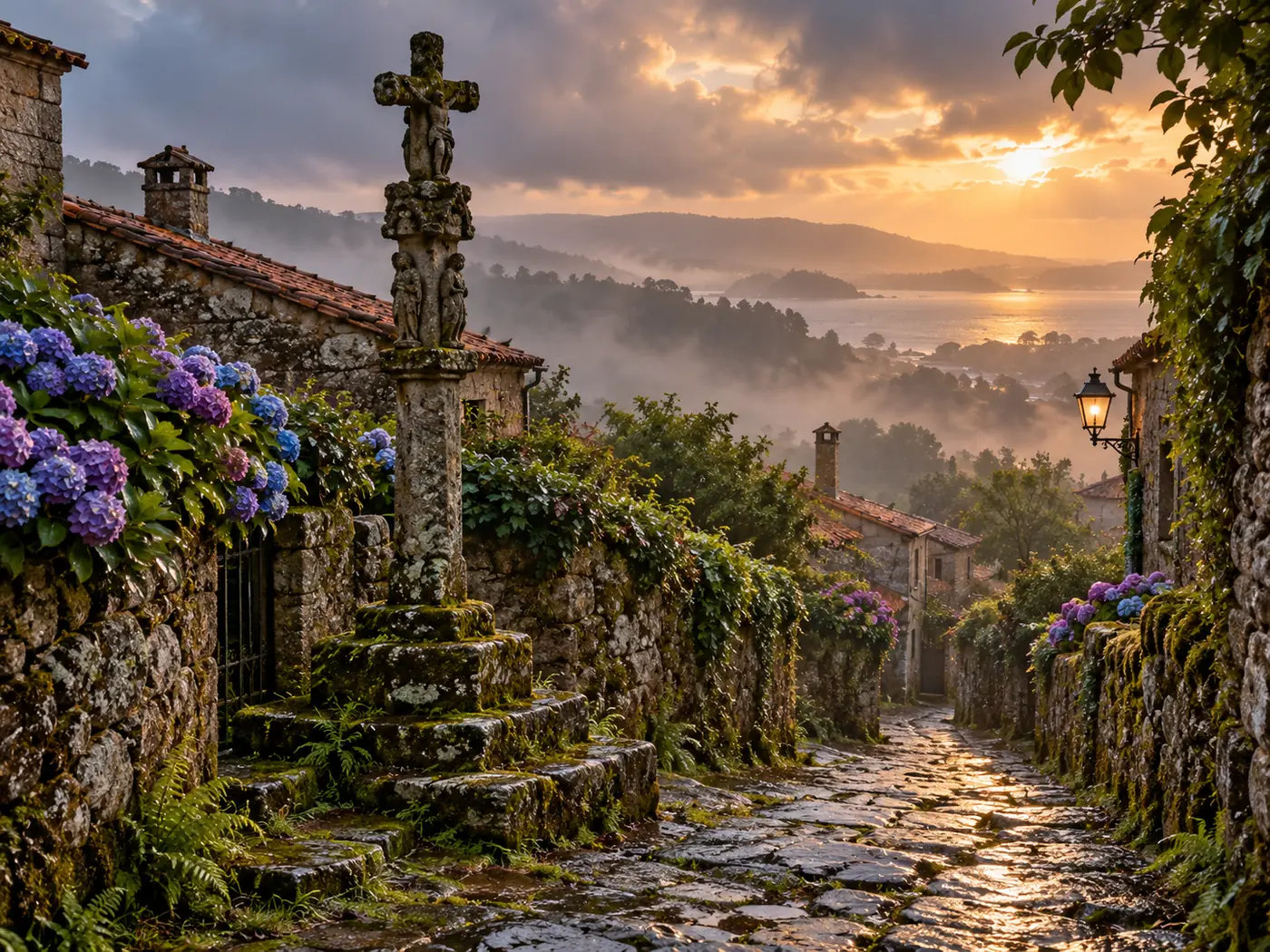
At crossroads and beside churches stand cruceiros, carved stone crosses that became one of the most recognizable features of the Galician landscape.
And then there is Santiago de Compostela.
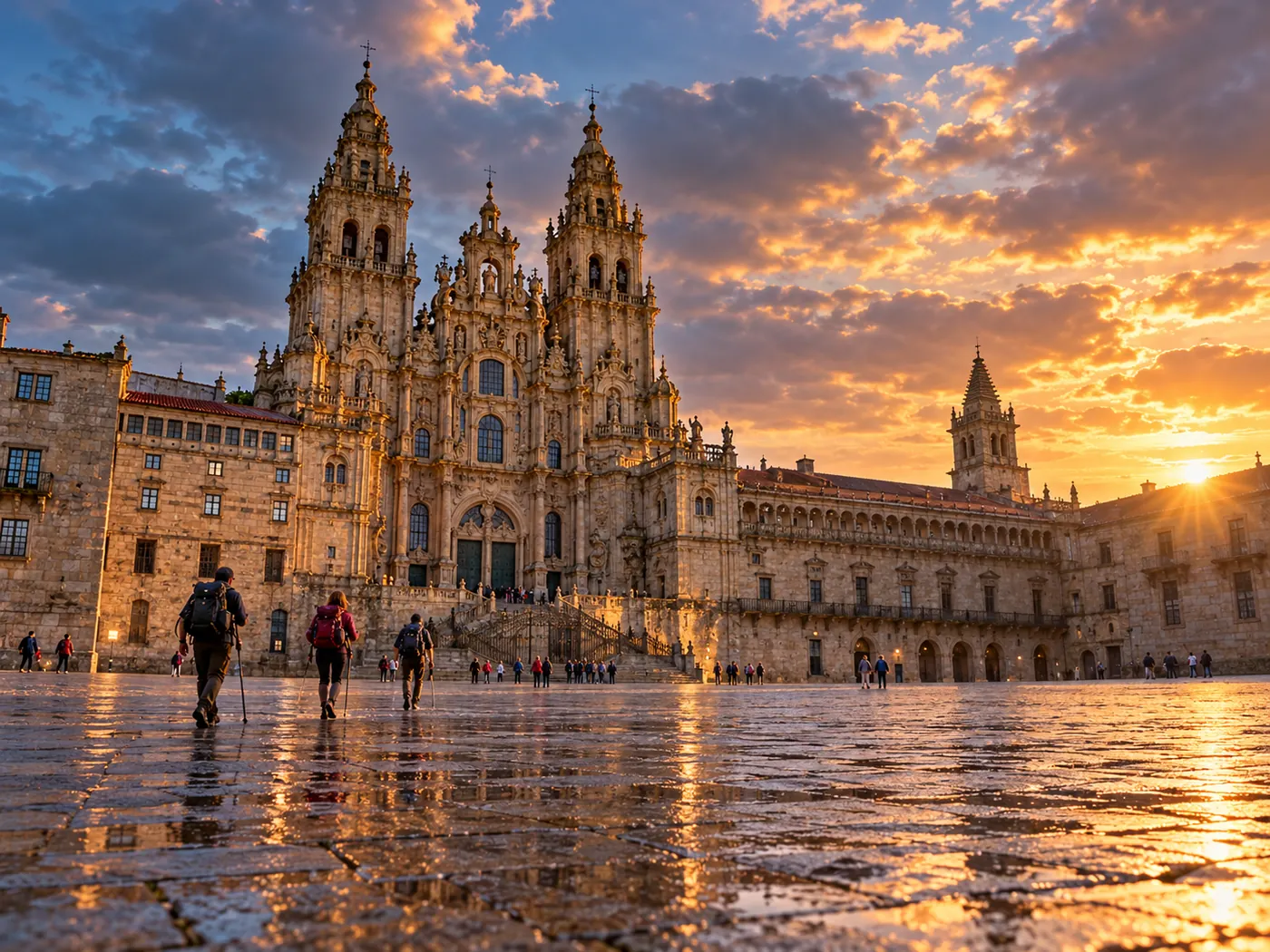
For more than a thousand years, pilgrims have crossed Europe toward the shrine traditionally associated with the Apostle James. The Camino de Santiago is religious for some, cultural for others, and deeply personal for many.
Arriving in the Praza do Obradoiro after days or weeks on foot can be moving even for people who do not consider themselves believers. The cathedral is the destination, but the power of the Camino often lies in everything that happens before reaching it: repetition, fatigue, conversation, silence, and the gradual stripping away of unnecessary things.
I have walked the Camino de Santiago twice: once on the Camino Francés, or French Way, and once on the Camino del Norte, the Northern Way. Both experiences are part of how I remember Galicia. One thing still stays with me: despite the crowds and the growing commercialization, its spiritual dimension is still very much alive. You may not always find the solitude you imagined, but walking day after day with little more than you can carry has a way of making you look inward. You don’t have to be religious to feel that.
Octopus and the Following Day’s Walk
From the French Way, I also remember a stop for octopus and Galician orujo, a strong local spirit. The octopus left a wonderful memory; the following day’s walk proved rather harder. Some long lunches seem perfectly reasonable until it is time to start walking again the next morning.
In Galicia, aguardiente is called augardente. The type known as orujo is distilled from grape pomace, the skins and other solids left after winemaking. It is a tradition best enjoyed slowly, especially when another day of walking lies ahead.
The Camino de Santiago will have its own article in ÖNEAY. For now, this is just a glimpse of my two experiences: the spiritual side, the effort, and the meals that become part of the journey too.
A Coast You Can Eat
Galician cooking begins with an unusual advantage: access to some of Europe’s richest fishing and shellfish waters.
Barnacles gathered from dangerous rocks, spider crab, velvet crab, clams, scallops, oysters, mussels, octopus, hake, turbot, and many other species appear with minimal ceremony because the product is expected to speak for itself.
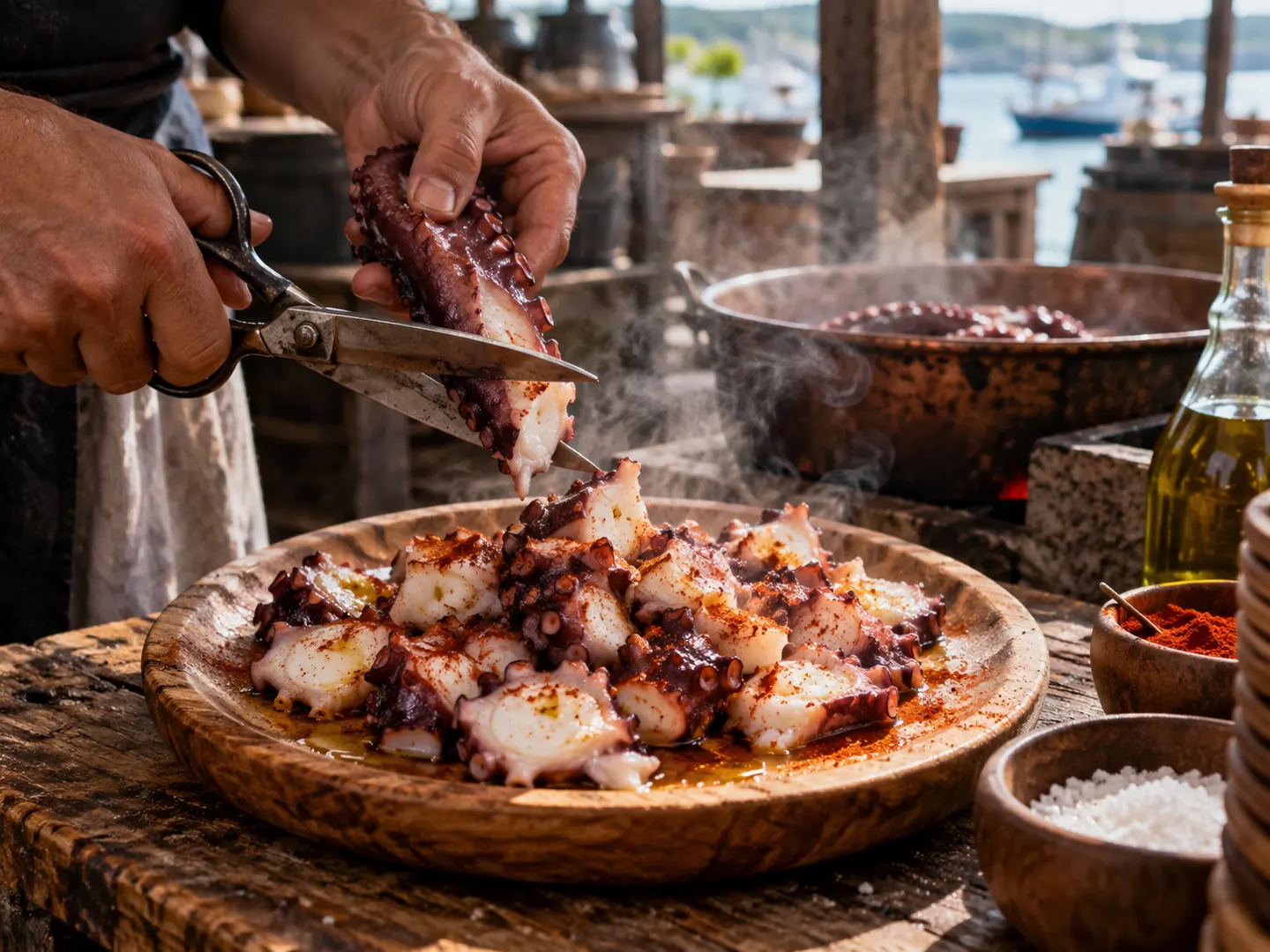
The great icon is pulpo á feira. Octopus is cooked until tender, cut into pieces, arranged on a wooden plate, and seasoned with coarse salt, olive oil, and paprika. At fairs and festivals, the sight of pulpeiras working beside steaming pots is as important as the dish itself.
Galician empanada follows a different logic: a golden crust encloses fillings that can range from tuna and peppers to scallops, cod, meat, or seasonal local specialties.
From inland Galicia come lacón con grelos, winter broths, pork dishes, and cheeses such as Arzúa-Ulloa and smoked San Simón da Costa. Almond-rich Tarta de Santiago closes the meal with the simplest of symbols: the cross of Santiago dusted in sugar over its surface.
The region’s wines deserve the same attention. Albariño from Rías Baixas, mineral whites from Ribeiro, heroic vineyard terraces in Ribeira Sacra, and wines from Valdeorras all express very different Galicias within the same landscape.
Between Faith and Folklore
Galicia has always had a rich relationship with the invisible.
Fog, forests, ancient hillforts, crossroads, and isolated paths became settings for stories of meigas, spirits, trasnos, mysterious mouros, and the Santa Compaña — a legendary nighttime procession associated with death.
The old saying captures the Galician attitude perfectly: one may not believe in witches, but “there are some, there are.” It is less a declaration of superstition than a wink toward the possibility that reason does not explain everything.
Christian traditions and older folklore coexist throughout the region, sometimes so closely that separating them becomes difficult. That layering is part of Galicia’s cultural texture.
A Language Made for Longing
Galician is closely related to Portuguese, with which it shares medieval roots. It is spoken in homes, schools, literature, music, public life, and ordinary conversation across the region.
Some of Galicia’s most powerful cultural ideas are carried by words that resist clean translation.
Saudade, shared with the Portuguese-speaking world, suggests longing for someone, somewhere, or something absent. Morriña is more specifically tied to homesickness and yearning for one’s own land.
Those feelings became especially important in a region marked by emigration. During the nineteenth and twentieth centuries, large numbers of Galicians left for Cuba, Argentina, Uruguay, Venezuela, and elsewhere. Their departure transformed both Galicia and the cities where they settled.
Returned emigrants built distinctive houses. Families remained connected across oceans. Galician associations flourished in Buenos Aires, Havana, and other cities. The idea of leaving — and perhaps returning — became part of the regional imagination.
Retranca, Restraint, and Modern Galicia
Galician humor often works sideways. Retranca is irony delivered so calmly that the listener may need a moment to realize what has happened.
This habit of ambiguity has produced one of Spain’s classic jokes: when you meet a Galician on a staircase, you may not know whether they are going up or down.
Behind the stereotype lies a culture shaped by difficult farming, uncertain seas, migration, and strong local communities.
Modern Galicia is also far more than a rural postcard. A Coruña faces the Atlantic beside the ancient Tower of Hercules. Vigo is an industrial and maritime powerhouse. Pontevedra has become internationally known for reclaiming much of its historic center for pedestrians. Lugo still lives inside one of the world’s best-preserved Roman walls. Ourense rises around thermal springs that have been used for centuries.
Tradition and modernity do not cancel each other here. They overlap.
Where the End Becomes a Beginning
Traveling through Galicia requires giving up a little control.
The weather may change. Fog may erase a view. Rain may send you into a tavern you never planned to enter.
That can be the best part.
A storm becomes an excuse for wine and conversation. A clear evening in the Cíes feels earned. Wet granite shines under streetlights. The smell of the Atlantic follows you inland.
Galicia is full of contradictions: edge and center, faith and skepticism, departure and return, melancholy and celebration.
It was once imagined as the end of the world.
Travel there slowly enough, and it can feel like the beginning of something instead.